
Pedestrian Flow Control Patterns in Landscape Design

Pedestrian Flow Control Patterns in Landscape Architecture
Table of Contents
- Why pedestrian flow control matters
- 1. Funnel
- 2. Split
- 3. Pause Node
- 4. Overlap
- 5. Bypass
- Diagram legend (recommended)
Why pedestrian flow control matters
In landscape architecture and public-realm design, circulation is not just about “getting from A to B.” Pedestrian flow shapes safety, comfort, accessibility, wayfinding, social life, and the overall performance of plazas, parks, streetscapes, campuses, and waterfronts.
The five patterns below are a practical toolkit for designing and communicating circulation strategies. Each one can be drawn as a clean infographic diagram, and each includes real-world project precedents to support your design narrative.

1) Funnel Pattern
Purpose: Narrow → focus → guide movement through gateways, pinch points, and transitions.
How the Funnel works
- Uses spatial narrowing, edges, and furniture to channel flow without aggressive barriers.
- Improves legibility at entrances and reduces chaos in high-footfall areas.
- Often paired with “pause pockets” so stopping does not block through-movement.
Diagram keywords
Real-world project precedents (3)
- Times Square Pedestrian Plazas — New York, USA (Snøhetta)
- Millennium Park — Chicago, USA
- Tate Modern (Switch House) Plaza — London, UK

2) Split Pattern
Purpose: One incoming flow divides into two or more route options based on program or destination.
How the Split works
- Reduces congestion by offering multiple legible choices.
- Supports different user intentions (commute vs leisure, play vs quiet).
- Works best when each branch has a clear visual identity or destination cue.
Diagram keywords
Real-world project precedents (3)
- Maggie Daley Park — Chicago, USA (MVVA)
- Superkilen — Copenhagen, Denmark (BIG + TOPOTEK 1 + Superflex)
- Bryant Park — New York, USA
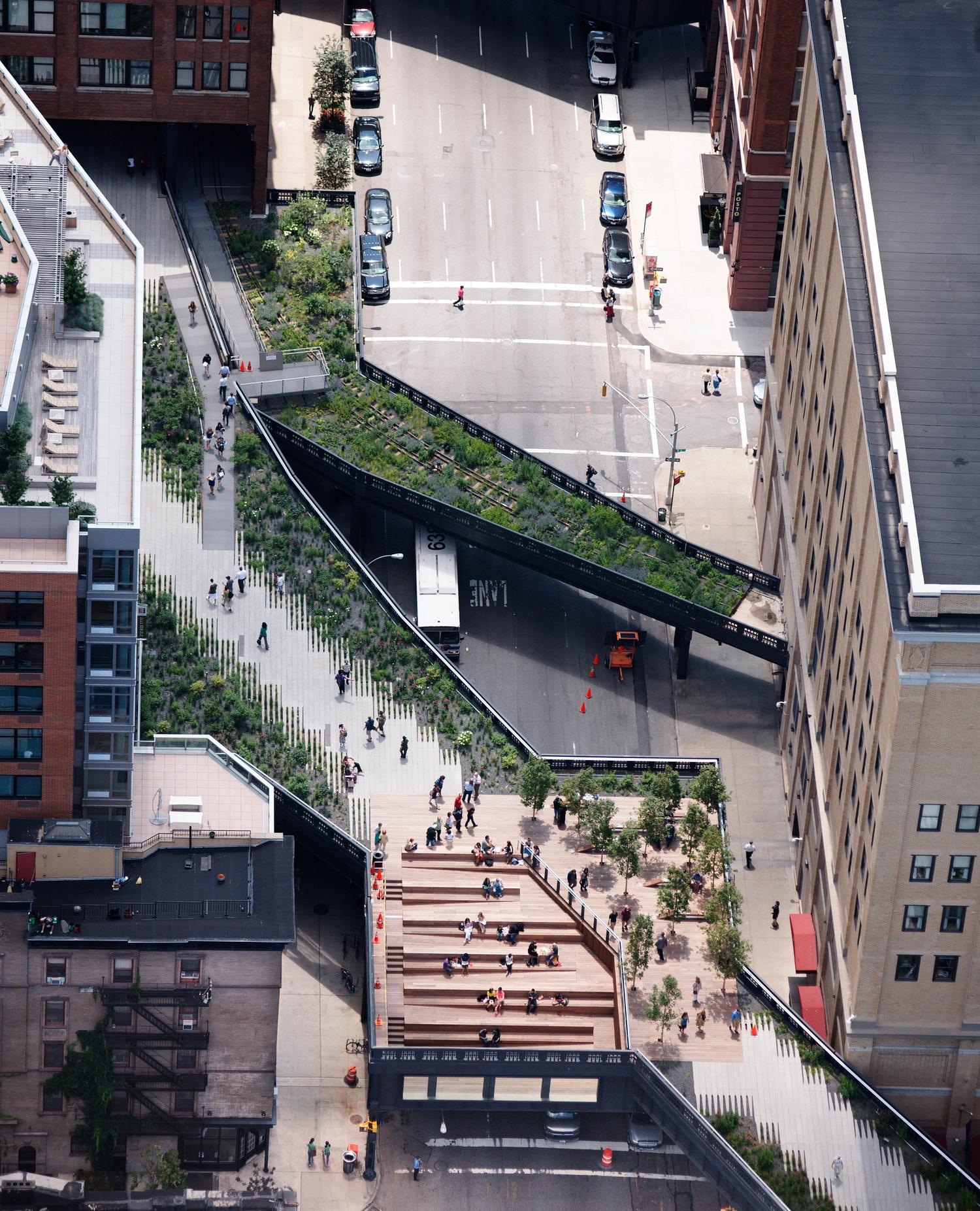
3) Pause Node Pattern
Purpose: Create intentional stopping points where people can linger without blocking primary flow.
How the Pause Node works
- Creates social value: sitting, waiting, meeting, viewing.
- Forms “eddies” off the main current of movement.
- Often uses seating edges, steps, overlooks, shade, or program anchors.
Diagram keywords
Real-world project precedents (3)
- The High Line — New York, USA (Field Operations + DS+R)
- Paley Park — New York, USA
- Granary Square — King’s Cross, London, UK

image: Downtown Cary Park
4) Overlap Pattern
Purpose: Design for intersecting flows that share space (shared surface, layered systems).
How Overlap works
- Accepts crossing paths instead of forcing strict segregation.
- Relies on behavior, speed changes, and subtle spatial cues (texture, edges, sightlines).
- Strong for civic plazas, shared streets, and event spaces.
Diagram keywords
Real-world project precedents (3)
- Exhibition Road — London, UK (shared-space street)
- Parc de la Villette — Paris, France (Bernard Tschumi)
- Federation Square — Melbourne, Australia

image: Photo courtesy of Memorial Park Conservancy
5) Bypass Pattern
Purpose: Separate fast through-movement from slow strolling and social movement.
How Bypass works
- Creates parallel routes: “fast lane” for commuters/joggers/cyclists, “slow lane” for leisure.
- Reduces conflict and improves comfort and safety for all users.
- Ideal for waterfronts, linear parks, greenways, and transit-adjacent public realm.
More Planting Design Tips:

How to Arrange Plants in Landscape Design
```


